Where Is Library Caches Com.app.xbs On Mac Os X
Boot ROM
- Where Is Library Caches Com.app.xbs On Mac Os X Mac
- Where Is Library Caches Com.app.xbs On Mac Os X 10
When the power to a Macintosh computer is turned on, the BootROM firmware is activated. BootROM (which is part of the computer’s hardware) has two primary responsibilities: it initializes system hardware and it selects an operating system to run. BootROM has two components to help it carry out these functions:
POST (Power-On Self Test) initializes some hardware interfaces and verifies that sufficient memory is available and in a good state.
EFI does basic hardware initialization and selects which operating system to use.
Oct 07, 2019 Each file stays right where you last saved it, and downloads when you open it. Files that you’ve used recently remain on your Mac, along with optimized versions of your photos. If you haven't yet upgraded to macOS Sierra or later, learn about other ways to free up storage space. Aug 08, 2013 In OS X v10.7, the boot loader looks for the unified prelinked kernel. This cache contains all kernel extensions that may be needed to boot a Mac with any hardware configuration, with the extensions already linked against the kernel. Jan 12, 2020 It's not clear why Apple decided to hide the user's Library folder, but you have multiple ways to get it back: two Apple provides (depending on the version of OS X you are using) and one in the underlying file system. The method you use depends on whether you want permanent access to the Library folder or only when you need to go there. Jul 06, 2018 Dr. Cleaner offers a free and effective way to clear cache on the Mac. It removes all unnecessary files that slow down your system in one click. Providing a one-stop solution for Mac OS maintenance, Dr. Cleaner removes every junk file including app cache, browser cache, library caches, log files, iTunes and iOS temporary files, and so on.
If multiple installations of OS X are available, BootROM chooses the one that was last selected by the Startup Disk System Preference. The user can override this choice by holding down the Option key while the computer boots, which causes EFI to display a screen for choosing the boot volume.
The Boot Loader
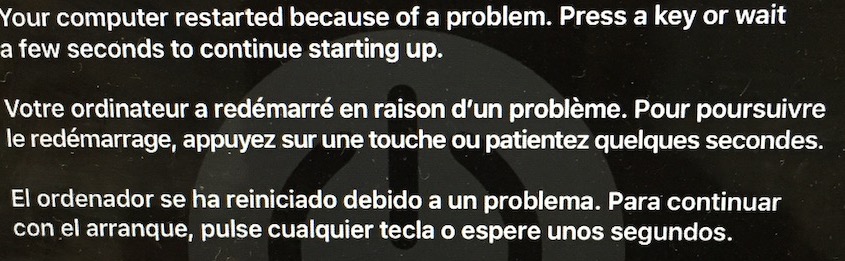
Once BootROM is finished and an OS X partition has been selected, control passes to the boot.efi boot loader. The principal job of this boot loader is to load the kernel environment. As it does this, the boot loader draws the “booting” image on the screen.
If full-disk encryption is enabled, the boot loader is responsible for drawing the login UI and prompting for the user’s password, which needed to access the encrypted disk to boot from it. (This UI is drawn by loginwindow otherwise.)
In the simplest case, the boot loader can be found in the /System/Library/CoreServices directory on the root partition, in a file named boot.efi.
Note: Booting from a UFS volume is deprecated as of OS X v10.5.
In order to speed up boot time, the boot loader uses several caches. The contents and location of these caches varies between versions of OS X, but knowing some details about the caching may be helpful when debugging kernel extensions.
After you install or modify a kernel extension, touch the /System/Library/Extensions directory; the system rebuilds the caches automatically.
Important: You should not depend on the implementation details of the kernel caches in your software.
In OS X v10.7, the boot loader looks for the unified prelinked kernel. This cache contains all kernel extensions that may be needed to boot a Mac with any hardware configuration, with the extensions already linked against the kernel. It is located at /System/Library/Caches/com.apple.kext.caches/Startup/kernelcache.
In OS X v10.6 and earlier, the boot loader first looks for the prelinked kernel (also called the kernel cache). This cache contains exactly the set of kernel extensions that were needed during the previous system startup, already linked against the kernel. If the prelinked kernel is missing or unusable (for example, because a hardware configuration has changed), the booter looks for the mkext cache, which contains all kernel extensions that may be needed to boot the system. Using the mkext cache is much slower because the linker must be run. On OS X v10.5 and v10.6, these caches are located in /System/Library/Caches/com.apple.kext.caches/Startup/; on previous versions of OS X, it was located at /System/Library/Caches/com.apple.kernelcaches/.
Finally, if the caches cannot be used, the boot loader searches /System/Library/Extensions for drivers and other kernel extensions whose OSBundleRequired property is set to a value appropriate to the type of boot (for example, local or network boot). This process is very slow, because the Info.plist file of every kernel extension must be parsed, and then the linker must be run.
For more information on how drivers are loaded, see IOKit Fundamentals, the manual page for kextcache, and Kernel Extension Programming Topics.
Rooting
Once the kernel and all drivers necessary for booting are loaded, the boot loader starts the kernel’s initialization procedure. At this point, enough drivers are loaded for the kernel to find the root device.
The kernel initializes the Mach and BSD data structures and then initializes the I/O Kit. The I/O Kit links the loaded drivers into the kernel, using the device tree to determine which drivers to link. Once the kernel finds the root device, it roots(*) BSD off of it.
Note: As a terminology aside, the term “boot” was historically reserved for loading a bootstrap loader and kernel off of a disk or partition. In more recent years, the usage has evolved to allow a second meaning: the entire process from initial bootstrap until the OS is generally usable by an end user. In this case, the term is used according to the former meaning.
As used here, the term “root” refers to mounting a partition as the root, or top-level, filesystem. Thus, while the OS boots off of the root partition, the kernel roots the OS off of the partition before executing startup scripts from it.
Boot≠Root is a technology that allows the system to boot from a partition other than the root partition. This is used to boot systems where the root partition is encrypted using full-disk encryption, or where the root partition is located on a device which requires additional drivers (such as a RAID array). Boot≠Root uses a helper partition to store the files needed to boot, such as the kernel cache. For more information on how to set up the property in a filter-scheme driver, see Developing a Filter Scheme in Mass Storage Device Driver Programming Guide.
Copyright © 2002, 2013 Apple Inc. All Rights Reserved. Terms of Use Privacy Policy Updated: 2013-08-08
Nowadays, almost every person owns a Smartphone or a personal Computer.
And thus, he must be aware of the computing words like Caches and Cookies.
Every site or system has its hardware or software sections, which stores the data that has been searched by the user.
This data is known as Cache.
It is just a temporary file created by apps, browsers and many other programs to help your Mac run faster.
Hardware Caches include CPU Cache, GPU Cache and DSPs (Digital Signal Processors), whereas Software Cache includes Disk/System Cache, User Cache and Web Cache.
Caches are used for future use.
They tell us about the things those were worked on earlier.
This helps in getting served with our past work or its duplicate data.
But we also can’t deny the fact that though caches come in small size, yet they sometimes reach up to gigabytes and take up large space and memory of our device.
Caches, be it of any type, needs to be deleted time to time.
Unlike Windows, there is a whole different procedure to delete cache files in Mac.
We’re serving you with some simple ways to remove the unrequired Caches in your device.
Use them and enjoy the freed up space and put photos or songs into your Mac.
Also Read: 5 Best FREE Mac Cleaning Software
How To Clear Cache on Mac?
#1. Deleting the Web Cache (In Safari):
If you’re a Mac user, it is entirely possible that Safari is your default browser.
Surfing the Internet of course ends up giving a lot of cache files, which need or should I say MUST be deleted before it clogs all your space.
The cache files in Safari can be deleted by following these ways:
1. Open Safari on your Mac by finding it from Spotlight Search.
2. Go to Preferences in the Menu Bar.
3. A window with many options like General, Tabs, Security, Passwords etc. will appear. Click on the Privacy tab there.
5. Now click on Remove all Website Data.
6. A window asking you to confirm your choice will appear.
7. Click on Remove Now.
All the website data and cookies of Safari will get deleted.
#2. Deleting the Web Cache (in Chrome):
For the ones who use Google Chrome as the browser on their Macs, the following steps can be used to delete the cache:
1. Open Chrome and click on More Tools at the upper right corner of the screen.
2. A tab with Clear Browsing Data will appear. Click on it.
3. All the data will get deleted. You can also use the shortcut key “Command+Shift+Delete” from your keyboard.
#3. Deleting the System and Users Cache:
System Cache is present in the Library folder.
In some devices, Library folder is hidden by default.
You can find it by going to Go in the menu bar and pressing down the Option key on the keyboard.
The procedure mentioned below is required to be followed to delete system cache:
1. Open Finder > Click on Go in the menu bar and then click on Go To Folder. A window will get open.
2. Now, type ~/Library/Caches and hit Enter.
A new window with all the information of the data used will get open up.
You can choose after looking up the dates, sizes, or types of data which you want to delete and which you want to keep.
Deleting all the cache data is never recommended as some things are important and can be needed in near future.
3. Use the keys “Command+Delete” or drag the folder or file to the Trash folder to delete it completely.
Trash folder can be emptied by using Control/Alt key + Clicking on the trash icon.
#4. Deleting System and Web Cache Automatically:
You can also delete all the cache files just with a mere click.
This can be done with a magic tool named CleanMyMac3.
This tool makes the process of removing Cache very easy.
You can do it in only 3 steps.
1. Download CleanMyMac3.
2. Open it and select System Junk from the menu. You’ll see a Scan option at the bottom. Click on that.
3. After the complete scanning, click on Clean.
It will not only delete the Cache but will also clean your whole system.
Where Is Library Caches Com.app.xbs On Mac Os X Mac
How to reduce the size of photos library on mac free. Read our CleanMyMac3 review article to know about its other helpful features.
By the aforementioned ways, you can effortlessly clear the caches, cookies or any system or web history on Mac.
You’ll be amazed to see how much space and memory you’ll save on your system.
Share in the comments about your experience of using these tips.
Where Is Library Caches Com.app.xbs On Mac Os X 10
Also Read: What To Do If Your Macbook Freezes? – Mac Tips and Tricks